 Philip Joubert
Chapter 2
Figuring out what you want

Stop! Do you really need to hire?
“My first piece of advice about hiring is don’t do it. Employees are expensive, and add organizational complexity and communication overhead. Employees add inertia — it gets exponentially harder to change direction with more people on the team. Resist the urge to derive your self-worth from your number of employees.”
Sam AltmanOpenAI
Stick to a two pizza team until you have product-market fit
Keeping the team small has many benefits:
- Avoid the massive opportunity cost of hiring.
- Faster decisions, fewer meetings, more fun.
- No room for mediocre people.
- You can pay the team better.
- Extend your runway.
In general, hiring before PMF slows you down, and hiring after PMF speeds you up.
False beliefs that lead startups to overhire
- “If we had more people we could get more done.” Startups should feel resource constrained. It forces you to focus on the work that matters.
- “Hiring is a marker of progress.” When people visit your startup, they should be surprised how few people you have.
- “This person will help us figure out product-market fit.” You can’t hire your way to PMF. It’s on the founders to figure it out.
- “We can avoid a future problem by this hire.” You can’t foresee the future. Deal with problems once you’re actually facing them.
- “There’s room in the budget.” After a fundraising event it can feel like money is burning a hole in your pocket. Take a cold shower and sober up.
- “It’s important for my career to become a manager.” Many ambitious employees want to be managers and add pressure to add new layers.
Key concepts for startup hiring
- Value creation vs value protection
- Generalists vs specialists
- Hiring for what you know vs what you don’t
- The right kind of diversity
- Barrels vs ammunition
- Hiring for roles you’ve never done
- Hiring for the right stage
- Creating roles for people vs finding people for roles
Value creation vs value protection
Before making a hire you should know whether you’re hiring for a value creation role or a value protection role. You’ll be looking for different characteristics.
Value creation
Roles that add new value to the business. You generally want ambitious risk-takers in these roles. Look for potential.
- Engineering
- Marketing
- Sales
Value protection
Roles that protect the existing value in the business. You usually want calculated and conservative people in these roles. Look for experience.
- Legal
- HR
- Finance
Startups begin without any value, so build a team of value creators first. Value protection roles can actually be value dilutive if you add them too early. Delay them for as long as possible.
Generalists vs specialists
When you’re not yet sure what game you’re playing, you want an all-around athlete, not a goalkeeper. Smart generalists, especially in a world with AI, can get incredibly far. They are adaptable and, because they can play any game, you have the flexibility of figuring out the direction of the company.
Once you are certain of the direction you’re going and how you want to get there, then the value of flexibility dramatically decreases. At that point, specialists become very valuable. This is true on the company level and the functional level.
Hire what you know vs what you don’t
When you’re making early hires, you’ll need to decide whether to start by hiring in areas where you have experience or areas you don’t know.
Hire what you don’t know
Intuitively it seems best to hire for roles you don’t have experience with:
- Bring in expert knowledge where you’re weak.
- Focus on what you’re good at.
Hire what you know
In most cases it’s better to hire for areas you have experience in:
- You’re in the best position to assess talent for roles you know.
- It’s easier to manage them and get them productive.
- You become surprisingly competent with only 100 hours of actively learning a new function.
Hiring for roles you’ve never done
Eventually you will be forced to hire for functions you don’t understand at all, often for high stakes roles in your executive team. How can you spot exceptional people if you don’t even understand the role?
- Do the role yourself for a while. The very best way to know what you want is to act in the role. Not just in title, but in real action.
- Talk with experts to create a baseline. Use your network and board to find the best 2–5 people in the role and learn from them.
- Have someone excellent interview them. You can have someone who is excellent at that role help you with assessing candidates.
- Work on a real problem together. Spend time with them working on a problem together for a couple of days and have them write up their thoughts, whether that be a brief roadmap, problem statement and solution, or mocks.
The right kind of diversity
Despite what your LinkedIn feed says, DEI is not actually a magical process for creating better products. In fact, early on you want to hire people with common values and goals, who are all pulling in the same direction.
But there are forms of diversity that can add massive value:
- Diversity of problem-solving portfolio ensures that potential failures are spotted early and solutions are arrived at faster.
- Diversity of industry experience ensures the team deeply understands the rules and requirements of the field.
- Diversity of creativity creates a culture of lively conversations and brainstorming, as well as an atmosphere that welcomes innovation.
- Diversity of age mixes old and new ideas, methods and mindsets, between multiple generations.
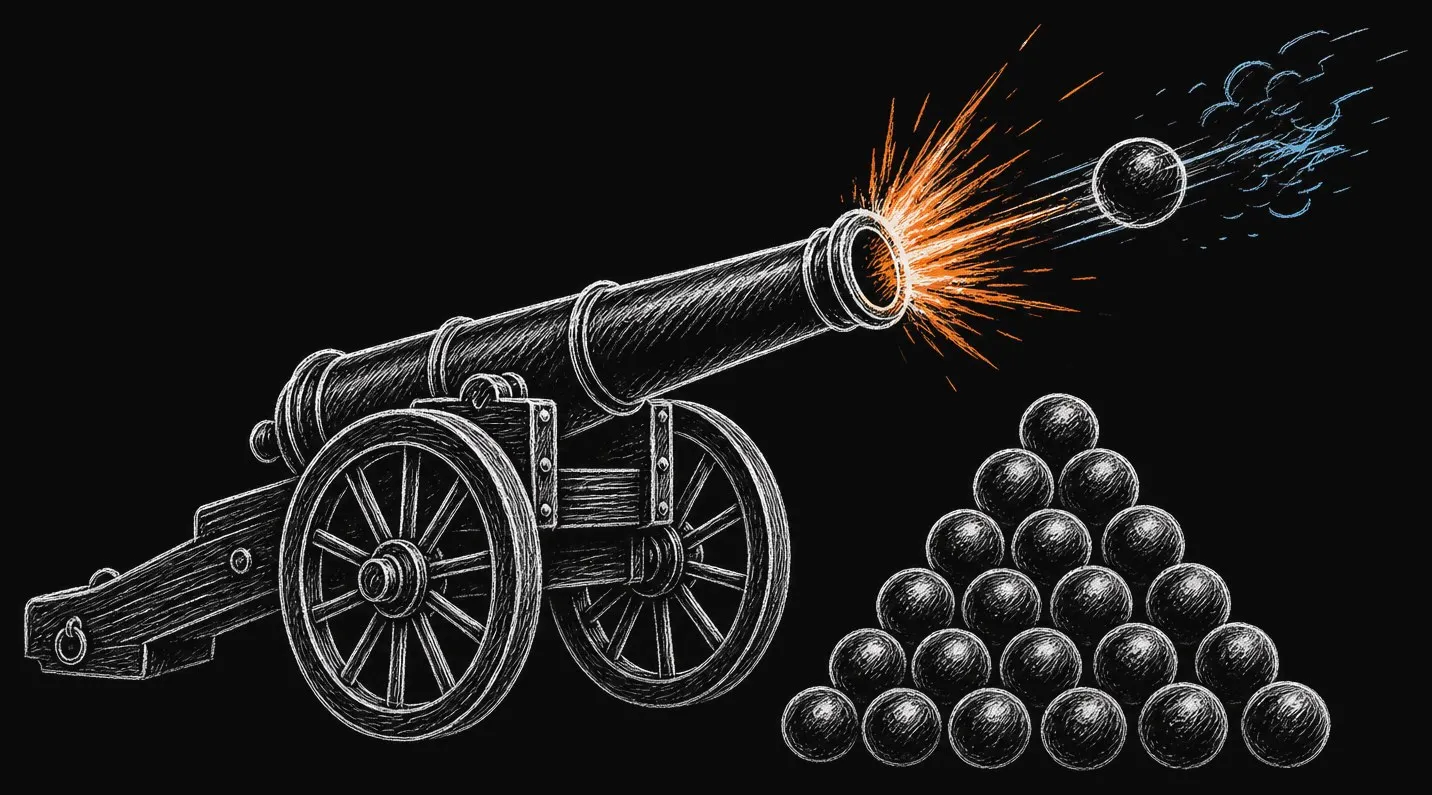
Barrels vs ammunition
We expect our throughput will increase as we add more people. In practice, our throughput actually depends on the ratio of barrels to ammunition:
- Most people are ammunition, meaning they’ll do what they’re told and do it to the best of their ability. Many of your best performers will be ammunition.
- Barrels are able to come up with original ideas, rally the team and find a way to get it done in your company. You’ll only have a few barrels, as they’re incredibly difficult to find.
You need both ammunition and barrels in your company, but barrels are almost always the bottleneck. Given that ammunition needs to be shot through barrels, an organization can only do as many projects as it has barrels.
Hiring for the right stage
It’s critical to hire people who fit your current stage. One of the failure modes for startups is to hire people from large, successful companies. When it works this can be a game changer, but more often than not these hires bomb. The root of the problem is a set of mismatches between startups and big companies:
Rhythm mismatch. Large company people expect work to come to them, but startups require you to make things happen yourself.
Skill mismatch. Big company skills don’t translate well to startups. In fact, they can be actively harmful to the company.
Startup skills
- Getting shit done
- High quality hiring
- Domain expertise
- Creating processes
- Creative problem solving
Big company skills
- Complex decision-making
- Prioritization
- Org design
- Process improvement
- Org communication
Characteristics of A players
“‘He’s not hungry but has the perfect experience’ never ended with a good hire. Hunger can often make up for lack of experience, but experience will never make up for lack of hunger.”
Erez DrukFreed.ai
- Hunger. A players have an abundance of drive and grit. They have something to prove and are willing to work incredibly hard to do so.
- Get shit done. Regardless of how smart someone is, if they’re unable to crank out a large amount of great work, they’ll weigh down your startup.
- Optimistic. Startups face impossible odds. You need people who see the glass half full, if only because you spend all day with them.
- High standards. They aim to be world-class at what they do and want to work with a team that does as well. To them, mediocrity isn’t just unwelcome; it’s offensive.
- Relentlessly resourceful. They find a way to achieve things against all odds. If there is a wall in their way, they’ll go over it, under it or become friends with it.
Hunger
Every top performer has hunger in huge measure. They’re never satisfied, as they’re driven by an insatiable urge to achieve more and improve themselves.
This hunger acts as a force multiplier for them. They’re not afraid of working hard and they know that great things are achieved through great effort.
There are a few things to look out for when assessing hunger. Firstly, look for people who’ve had a challenging background (e.g. grew up in poverty) but are nonetheless on par with their peers in skill and knowledge.
Secondly, look for people who’ve been obsessed before. If they’ve never been deeply obsessed about something before, then it’s a bad bet to think your company will be the first.

Get shit done
Everyone in your team should have a massive bias to action. You need doers, not “thinkers”. Everyone should be highly proactive and follow through on what they said they’re going to do.
The inability to get things done manifests in many ways:
- Lack of urgency. No rush to push things forward.
- Easily distracted. Heavy procrastinator.
- Lazy. Some very smart people are basically lazy.
- Lack of follow-through. Starts but never finishes things.
- Argumentative. Arguing about how to do things rather than just doing them.
- Perfectionism. Spends excessive time refining details to achieve an “ideal standard”.
Optimistic
Humans only have a finite amount of energy and courage, which can be quickly dissipated by negative people. The rest of the world will be predicting your demise every day, and your team needs to be united in its belief to the contrary.
When things go horribly wrong at your startup, which will inevitably happen, you want the team to rally and remain excited in the face of adversity. People who need a day off to “process” news don’t belong in startups.
The right kind of optimism lets people act in a paradoxical manner: they have the knowledge they’re making a decision with a 60% chance of being correct, but have a feeling of confidence that it is 100% correct.
You’ll know you’re dealing with the right kind of optimism when, after talking to them, you feel like you’re ready to run a marathon on a treadmill with max incline.
High standards
A players hold themselves to (almost) unrealistic expectations. Doing mediocre work is incongruent with their very being.
You’re not looking for people who want to be kinda good. They should want to be world-class.
While it’s possible to teach high standards, it usually takes years. So look for it during the hiring process.
The most obvious way to spot high standards is looking at their past work. Is it excellent? Another way is to find out if they’ve spent the time to become good at anything they adopt as a hobby.
Relentlessly resourceful
Your early team should all be relentlessly resourceful. There should be things in their past which convey that they’re able to make things happen, against all odds. If there is a wall in their way, they’ll go over it, under it or become friends with it.
Resourcefulness requires a mix of agency, energy, creativity and a willingness to endure discomfort. The right people get a thrill from figuring out how to solve impossible problems.
One of the best indicators of resourcefulness is “immigrant mentality”. Have they moved from their hometown? That’s a good sign. Have they moved from their home country? That’s an even better sign.

From least to most helpful:
- “There is a problem.” Then you walk away, leaving someone else to deal with it.
- “There is a problem, and I’ve found some causes.”
- “Here’s the problem, here are some possible causes, and here are some possible solutions.”
- “Here’s the problem, here’s what I think caused it, here are some possible solutions, and here’s the solution I think we should pick.”
- “I identified a problem, figured out what caused it, researched how to fix it, and I fixed it. Just wanted to keep you in the loop.”
1 bar: least helpful5 bars: most helpful
Red flag characteristics of early employees
- Uncomfortable with risk. You need people who are comfortable with uncertainty and taking bets. They shouldn’t freak out when things change.
- Entitled. Most startup work is grunt work. No task should be beneath you. Anyone who primarily wants to do “strategy” or manage people is not going to make it.
- Bad judgment. If everyone in your team has good judgment, you need fewer rules, which lets you go much faster. Having just one person with bad judgment means you’ll need to create a lot of rules.
- Lacks ownership mentality. The default in startups is to go the extra mile. You need people who care so much about achieving the outcome that they’re willing to do whatever it takes.
- Needs structure and clear direction. The best startups often feel like a hot mess because they are a hot mess. Your team needs to thrive within ambiguity and derive satisfaction from fixing what’s broken.
- Wants work-life balance. Work-life balance means keeping work in a guarded cage. Giving it adequate time, attention and energy. Adequate implies average and average doesn’t fare well in startups.
What’s the point of job descriptions?
Everyone hates writing job descriptions. Which explains why most of us end up stealing them from job boards, making a few edits and calling it a day. Writing a job description may feel like busy work but it’s actually a super high leverage activity.
Nailing your job description makes the rest of the hiring process much easier:
- No candidate is perfect, so clarity about the necessary requirements and more importantly the tradeoffs is vital.
- It keeps you honest during the hiring process so desperation doesn’t get the best of you.
- It’s much easier to sell fit later on when you know exactly what you want.
- If you don’t decide what’s important to your company, the other interviewers will.
Consider the tradeoffs upfront
When speaking to actual humans you’ll quickly learn that nobody meets all the requirements perfectly. The best people tend to crush the important parts of the scorecard while having weaknesses in the less important areas.
It’s much easier to evaluate candidates if you’re very specific about the qualities that really matter and you’ve considered the tradeoffs you’re willing to make. For example, if you’re hiring software engineers you might ask yourself these questions:
- Do you need fast, iterative programmers or careful rigorous programmers?
- Do you need someone motivated by solving technical problems or building product?
- Do you need skill with a particular technology or can a smart programmer learn it on the job?
- Is academic CS/math/algorithm important or not?
Critical incidents
It may be worth adding critical incidents to the scorecard as well. Critical incidents are commonly occurring situations that the new hire will confront and must be able to master to be considered a strong performer.
For example: if you’re working in an unsexy industry and bootstrapped, the VP Engineering will need to be excellent at attracting, developing and retaining talent with limited resources.
It’s not always obvious what these critical incidents are, especially when hiring for a role you’re not familiar with. Go out and talk to top performers in those roles and ask them.